Uranias gardens, synopsis and the birth of a new project
“At intervals, the entangled n-dimensional flow of my project was freezing by my intercepting observation and was recalibrated in the analogous time frame”.P. Kasda, Mein poezie is een reis in de geegtelidjke textuur vaan het land, 3000 Letters X, The Seven Sleepers Leuvain 1994
"For an elktikon hemar* of seven years we have been planting seed ideas, (things per se), in the fertile fields of Uraniasgardens, eavesdropping their growth, with minimum interference. Uranias Gardens is a mental space that emerged during a friendly gathering while discussing the nature of time and space; a digitally substantiated mental field, receptive to the seeding, sprouting and sharing of new ideas and projects to be realized in real space.
During each realization process, modified by the peculiarity of each specific site, I could observe the intrinsic power of formulated Ideas to morph and organize themselves into spacetime structures, attracting the creative human and non-human components necessary for their fleshing out in our emergent synesthetic hyper-spaces, reappropriating with our visionary repurposing those experimental sites.
Aligned with Xene**, i was monitoring, from inside-out, the way my pattern-setting ciphers were encoded into coherent virtual constructs, the way my consciousness was mapping itself in the landscape around me; the way i was recreating and simultaneously recognizing with an"anagnoristikon meidiama"*** the hermetic ancient symbols i was stumbling upon, during my parcours in the phasmatic topology of Greece...
Uraniasgardens was a dynamic cross-pollinating working field in which i could set Trojan pattern- strategies, device my own tools to explore, with Metissian**** cunning, uncharted spectral territories integrating them in our conscious space perception..
During this self-combustive process I kept on stumbling concretely on powerful abstract concepts, rediscovering them anew, forepacing, at times, tech innovations and discoveries.
By formulating my projects' praxes, in my parallel self-reflexive narrative texts, i could assimilate and possibly anchor their contents on on-going academic research; a self-regenerating, uroboric artistic-linguistic process crammed with articles and essays, while juggling live action with spectral space elements in pliable time contractions and expansions...".
Aligned with Xene**, i was monitoring, from inside-out, the way my pattern-setting ciphers were encoded into coherent virtual constructs, the way my consciousness was mapping itself in the landscape around me; the way i was recreating and simultaneously recognizing with an"anagnoristikon meidiama"*** the hermetic ancient symbols i was stumbling upon, during my parcours in the phasmatic topology of Greece...
Uraniasgardens was a dynamic cross-pollinating working field in which i could set Trojan pattern- strategies, device my own tools to explore, with Metissian**** cunning, uncharted spectral territories integrating them in our conscious space perception..
During this self-combustive process I kept on stumbling concretely on powerful abstract concepts, rediscovering them anew, forepacing, at times, tech innovations and discoveries.
By formulating my projects' praxes, in my parallel self-reflexive narrative texts, i could assimilate and possibly anchor their contents on on-going academic research; a self-regenerating, uroboric artistic-linguistic process crammed with articles and essays, while juggling live action with spectral space elements in pliable time contractions and expansions...".
*ελκτικόν ήμαρ: attractive time-chunk of nowness
**Xene : reference to my mythical twin 'performing her liturgical act in the other side of the mirror'; the ritual sustaining the (poly) configuration of my actual life, as described in my book "When that word swallowed me".
***anagnoristikon meidiama: a special type of knowledge through identification of the seeker with the sought, expressed in the archaic smile of the Kouros.
****Metissian manoeuvres stands for Odyssea's ruse, this special Greek Noessis as described in Vernant-d Etienne's "Metisse la Ruse Grecque"
PolyXene Kasda, Metisse and the Heracleian Stone*****, or, the irresistible charm of real-life project-plotting (narrative essay on-the-make).
*****reference to the legendary magnetic stone of Samothrace that was inspiring its magnetic enthusiasm to the iron rings of the initiates and they in turn transferred its power to more and more rings creating a long chain of load-stones reaching our days. The Heraklia Lithos stands for a psychophysical element engrailed in our structure, making its presence felt by the gravity of its own void; the urge that drives us out of our skin which i call SEM or Something Essential Missing.Some name it Lapis Exilis , others The Gene of God, I name it ΠΑΙ in my book PAI, Seven Sleepers co.ed Uni.Press Lucian Blaga, 1997..
Uraniasgardens 2009-2016 projects*: the symfiliotic merging of actual /inner/ spectral space
Special attention was given to clues providing a psycho-anthropological synesthetic signature of each place :
- the environment-subjectivity affective entanglement
- the phasmatic affect of ancient relics on our cognitive processes and the possible restitution of their ghost imprints that seem inseparable from our unconscious consciousness
local benefits: topological re-evaluations, myth- spectral and agro- space awareness, cross-cultural interchange, residents'creative involvement, creation of permanent,international polycentric art collections.

*Gargling Sky, village/ network, for the Year of Astronomy-2009-
 overview polycentric international art- constellation spread throughout the remote meteorite- showered village Gergeri, Crete.
 Crumbling traditional buildings, 17th c. watermills, elderly homes, abandoned old school were restored in one morning to this end.
Engagement of the local youth, astrophysicists and shepherds.
Observation: spontaneous revival of Ariadne's thread simulacrum by the youth of the village who linked the circuitous parcours of the exhibition with constellations made of ribbons attached on the walls of the houses- spontaneous participation of housewives offering local delight and shepherds who participated with their self-made musical instruments.
The Forest of Rouvas, a sanctuary of biodiversity was included in the inauguration parcours, where the residents cooked meat in the traditional "andikristo"way in a configuration echoing the orbits of the planetary system around the sun (fire).
Observation: spontaneous revival of Ariadne's thread simulacrum by the youth of the village who linked the circuitous parcours of the exhibition with constellations made of ribbons attached on the walls of the houses- spontaneous participation of housewives offering local delight and shepherds who participated with their self-made musical instruments.
The Forest of Rouvas, a sanctuary of biodiversity was included in the inauguration parcours, where the residents cooked meat in the traditional "andikristo"way in a configuration echoing the orbits of the planetary system around the sun (fire).
Art co-curators Chrysa Vathiaanaki, Donatella Bisutti, Auspices Municipality of Rouvas, now, Gortys
The dispersive installation was extended in Croisees d'Arts, Chateau London, France (c0-cur. K-Droz Paris)
relevant research-narrative articles
The dispersive installation was extended in Croisees d'Arts, Chateau London, France (c0-cur. K-Droz Paris)
relevant research-narrative articles
P. Kasda, The Gergerian Experience, Artooth.gr articles
P. Kasda, Gargling Sky, newspaper of the Greek Chamber of the Arts ΕΕΤΕ, nb.158 |
| from the Samothrace museum |
Trans-border, transloci artworks and cultus performances on Time as a Child /ΠAI playing/ΠΑΙΖΩΝ, inspired by Kasda's poetic narrative essay PAI, published in French, Flemish and Romanian by the Seven Sleepers Leuvain co-ed. Uni.Lucian Blaga Sibiu 1997
The event was extended in Bulgaria, Thebes, Patmos, Athens (Technopolis), Lecce Italy (Primopianogallery)..
and were enriched by the local Children' forest installation:"Leleki (stork), leleki come back".
The event was extended in Bulgaria, Thebes, Patmos, Athens (Technopolis), Lecce Italy (Primopianogallery)..
and were enriched by the local Children' forest installation:"Leleki (stork), leleki come back".
Org. Union of the Cultural Associations of Evros gen. secretary Katerina Kaltsou, Alexandroupolis, Samothrace
Site benefits: Permanent international EPOFE art collection ΠAI in Alexandroupolis-Samothrace
Exhibited in the Natural History Museum of Alexandroupolis.
art -.co-curators Dores Saquegna (Primipiano Italy) and Pierre Chirouze (K-Droz Paris).
Exhibited in the Natural History Museum of Alexandroupolis.
art -.co-curators Dores Saquegna (Primipiano Italy) and Pierre Chirouze (K-Droz Paris).
P. Kasda, PAI, the Seven Sleepers Leuvain co-ed. Uni.Lucian Blaga Sibiu 1997

 *The Samothrace Game -2011-, To be and not to be. Aye, this is the question!:
Psycho-physical reality game in the "virtual space of spectrality"(Derrida), favoring archetypal potentization, spectral /actual space transpositions, oscillations and intricate states of mind.
The landmark-images were remotely teledictated to game- imager A. Papantoniou in Athens, by the local residents' legend- freighted, subjective telenarrative, resulting in the creation of an affective, biomatic map of the island, painted on a set of 22 cards. The parcours cards of the deck could be shuffled and reshuffled by the participants creating alternative aleatory routes in their quest for inner/outer PAI.
A time-capsule was inserted inside the neolithic Gate of the Sun.
Open-ended game set to be enriched by the participants' interactions and the assimilation of the characteristics of the game in real life through the Proteus effect.
Kasda's basic concept was enriched by a game created and organized by IDEA; an emerging local cultural association of residents, which morphed itself to this end..
Open-ended game set to be enriched by the participants' interactions and the assimilation of the characteristics of the game in real life through the Proteus effect.
Kasda's basic concept was enriched by a game created and organized by IDEA; an emerging local cultural association of residents, which morphed itself to this end..
P. Kasda, Concept of the treasure hunt Looking for PAI 2011, http://uraniasgardens.blogspot.com 2011
P. Kasda, Map of the hidden treasure PAI 2011in Samothrace. Ibid
T *Tu vas a Tuva? oueh je vais a Ithaca -2011-..
The project was first formulated for the apex 2011 contest with the title Tout va a Tuva? It was reformulated on paper in 2013 with primopianoatelier as The Ithaca-Salento experiment to be/not to be realized in the future. ....
 A playful contemporary version of Homeric Ithaca, inspired by R. Feynman's Tuva, the utopic space that has inspired poets to create epics driven by that self-devouring SEM, or, that Something Essential Missing that heroic conscient element engrailed in our human unconscious, retroactively charged with our human entelechy, that makes its power felt through the merciless attraction of its own void.
*«Πιθ΄ Ελλέβορον”/ Pith'Ellevoron / Drink Helleborus -2014- botanology and madness.
Agricultural topology affect on our mental health and cognitive processes
Agricultural topology affect on our mental health and cognitive processes
"Alert and flexible at the end of the line, I follow the unfolding of the self-combustive idea with which i am aligned and which is steadily growing out of itself, continuously ramifying, involving more and more creative people from all fields, winding its way through ordinary life, redefining space, sealing our future ". P. Kasda (Project diary 2014).
"and all these lovely irregularities revealing the defects of the standard model mined from its interior by the persisting Enigma revealing and hiding itself behind its own turbulence effects..." P. Kasda (Ibid)
"and all these lovely irregularities revealing the defects of the standard model mined from its interior by the persisting Enigma revealing and hiding itself behind its own turbulence effects..." P. Kasda (Ibid)
 |
| M.Manieri, Antikyra 2014 |
Helleborus is a local herb known for healing madness.
Pith'Ellevoron is an ancient Greek saying meaning "drink a sedative, stop talking crazy".
Pith'Ellevoron is an ancient Greek saying meaning "drink a sedative, stop talking crazy".
Org. Allotropia local popular academy- artistic co-curator: Primopianogallery Italy, under the auspices of the Greek Ministry of Culture.
Site benefits: Permanent art and agro collection in Allotropia museum.
http://uraniasgardens.blogspot.gr/2014/02/a-seed-project-is-sprouting-in-Antikyra
poly Kasda, .http://uraniasgardens.blogspot.gr/search014PROJECT Drink Helleborus /"ΠΙΘ' ΕΛΛΕΒΟΡΟΝ!" (pith'elevoron) continuously re-edit
P. Kasda, Pith'Elevoron/ Drink Helleborus http://festival.culture.gr/2014/10/
*Sphinx 2015-16, The Hidden Thebes Festival on the contagious effect of spectral Thebes. Ontological entanglement of man/nature/myth,
 the Riddle of the Sphinx, or, the potentized incubation of our latency- the haunting affective presence of stone-walled Thebes.
pattern-setters, general curators: Konstantin Angelou, Poly Kasda
 The Sphinx Hidden Thebes Festival was an outgrowth of "Miorita, Melusina and the Sphinx", Kasda- Angelou telecommunications project probing “mioritic”unconscious space (Lucian Blaga), digital deterritorialization and the critical instability of the culturally uninformed model of hybrid Europe, selected by Arscenic French Association for the twin Capitals of Europe 2007..

 the Riddle of the Sphinx, or, the potentized incubation of our latency- the haunting affective presence of stone-walled Thebes.
pattern-setters, general curators: Konstantin Angelou, Poly Kasda
artistic co-curators: Dores Saquegna (visual arts), Maria Frangi (theatre), Maria Cheetara (architecture)
Auspices: Athens School of Fine Arts - Greek Ministry of Culture.
P. Kasda, PROJECT SPHINX 2015 unveiling invisible THEBES, Greece, continuously re-edited.25.2.15
P. Kasda, When that word swallowed me, Sphinx Festival of Hidden Thebes co-ed.Poesia e Conoscenza Milan 2016
P. Kasda, When that word swallowed me, Sphinx Festival of Hidden Thebes co-ed.Poesia e Conoscenza Milan 2016
The Sphinx Hidden Thebes Festival was an outgrowth of "Miorita, Melusina and the Sphinx", Kasda- Angelou telecommunications project probing “mioritic”unconscious space (Lucian Blaga), digital deterritorialization and the critical instability of the culturally uninformed model of hybrid Europe, selected by Arscenic French Association for the twin Capitals of Europe 2007..P. Kasda, MIORITA, MELUSINΕ και η Σφίγγα των Θηβών: Tinkering με τα στοιχεία de differentes cultures. http://uraniasgardens.blogspot.com 8.10.14
P. Kasda, Project Miorita, Melusina and the Sphinx of Thebes, //uraniasgardens 2007
P. Kasda, topologie syncretique europeenne,2014, http://polyxenekasda.blogspot.com
*Sphinx 2017 Kadmos looks for Europe. Europe looks for Kadmos (under preparation) while i am writing this text, speculating on my previous projects, a new hyper-project is sprouting in Urania's Gardens; I can already feel, with the Kore's anagnoristikon meidiama (recognition smile), the hot breath of spectral Thebes rekindled on my spine...I listen to the murmuration of my subconscious mind swelling in the hiatus perforating the interface of spectral/actual Thebes; an absorbing spacetime bubble in which our next community experiment will/will not be held.)
General concept/ pattern-setting curators: Konstantin Angelou, Mariana Zikou, Poly Kasda. The whole city of Thebes is transformed into a language game playspace, crammed with linguistic codes, riddles and artifacts. Digital acoustic and olfactory topological maps of Thebes are materializing the eyeless Oedipian space of spectrality.
"mythical pedema is a Snakes and Ladders' board game, i.e. the ancient 'Game of the Goose', an ancient Egyptian symbol of the incarnation of the Invisible - in which a bad throw can throw you from end to start, inτο the growler's cell.. gradually, i realized that the rules of this game are primarily ethical, obeying to the boundaries of Logos and the solutions to the dilemmas are always based on the Golden Mean". P. Kasda, Surfing on the Medusa's Hair 1999, unedited.

Myth/Network projects 1990-2009 underlying and sustaining the Uraniasgardens projects 2009-2016- :
- Code Lexomorphes, 1991- 2009 -2017-: the intelligent design sustaining Greek language structure. Speaking sculptures and cryptographic patterns generated by the numerical modeling of Greek words based on the Ancient Greek mathematical codification of the Greek alphabet
 |
| P. Kasda, Lexomorphe ΑΝΘΡΩΠΟΣ |
 |
| P. Kasda, synthesis of Lexomorphes ΨΥΧΗ, ΟΝΟΜΑ, ΕΛΠΙΔΑ, ΑΝΘΡΩΠΟΣ |

 -Structuralist exhibition Homage a Stazewski Concept/ Form, Municipal Center of Athens 1991.
-Panhellenic Congress on Greek Language 2009, Old Parliament of Athens, org. Chamber of Fine Arts of Greece.
-Bienale di Poesia di Alessandria, Italy 2004-2008
-Uraniasgardens Congress for the International Year of Astronomy 2009, Municipal Center of Athens
-Flags, British Embassy of Beirut, UNESCO-MEADOWS-OFAA 2012. Lexomorphes were proposed as a mathematical inter-space communication code
Related articles and essays:
P. Kasda, Code Lexomorphes, the iconic dimension of Greek language”Poesia e Spiritualita review, Milan, Italy 2007.
P. Kasda, Chrysalis/Grail, Reflections of an Object of Truth, Verita e Dubbio 2004. XVII Bienale di Poesia di Alessandria,Joker, Italy 200
P. Kasda, project Myth/network, Τετάρτη Αποστολική, Municipal Pinacotheque of Athens1994-
Dedication to Polyxene Kasda,Tyflomyga review, Athens 2003-
P. Kasda, When that word swallowed me, narrative essay Sphinx,-The Hidden Thebes Festiva/ poesia e conoscenza 2016Artificial Intelligence Professor needles Poly Kasda's Conscious Eye, essay Southwiind /Amazon 2015
Sonorous landscapes: as team hyper-project "Kadmus looks for Europe 2017" starts morphing, i visualize Code Lexomorphes gigantic patterns covering Mt. Phikion of Thebes, the mythical mount on which the Sphinx was challenging voyagers with its lethal Self-regenerating Riddle. The word Phikion is derived from the name Phix, the ancient Greek name for the Sphinx.The idea is to convert the mountain into a linguistic riddle. ONOMA in Greek is interpreted by Socrates as that which gives self-birth to ON (the creature in question).
- Landscape semiotics-Affective hermeneutic maps of spectral Greece -1994-1996-, knowledge through mystic participation- herding the tantalizing trails of spectral space ossified symptoms, into a self- apocalyptic matrix - evocative landscape semiotics and language games.


 Mythologically augmented, anti-historical parcours in mythical sites of Greece - graphisms and sets of instructions encouraging the participants'identification with apocalyptic symbols condescendingly opening prosvassis to 'ekstatic' noetic hyperspaces emerging in actual life, through the participants' consensual synesthetic engagement.
"I was unleashing in the present the repressed imagery of my deep unconscious, which, to my surprise, I was now recognizing embodied in the vigilant topology of Greece, an ontological riddle that is incessantly defying our mortality under our feet”.P. Kasda, When that word swallowed me, Sphinx, the Hidden Thebes Festival editions 2016.
Project-maps:
-Tavrokathapsia, The Gate of Fire, crossing Crete 1994


"ancient symbols are seen as wormhole shortcuts in the fabric of spacetime condescendingly opening through anagnorisistic identification with the anonymous simulator of our reality game" P. Kasda, on the irresistible charm of real-life project-plotting (essay on-the-make).
-Tavrokathapsia, The Gate of Fire, crossing Crete 1994
-Arcteia, tracing Artemis (Artemeo means I AM), on the triangle linking Brauron Attica, Lykeon Mi. Arcadia, Icaria Nas..1996.
Realized under the auspices of the Municipal Radio of Athens 9,84F.M, with the participation of the Biennial of Poetry of Alessandria Italy,Τοuchstone poetry group for the XVth European Poetry Festival (Brussels), the European Poetry Network (Belgium), who adopted the Maps as a new form of generative poetic expression.


"ancient symbols are seen as wormhole shortcuts in the fabric of spacetime condescendingly opening through anagnorisistic identification with the anonymous simulator of our reality game" P. Kasda, on the irresistible charm of real-life project-plotting (essay on-the-make).
Relevant articles and essays:
P. Kasda, Pyrisporos. Art-Mythology-Informatics, Greek interdisciplinary hyper-essay, Aigokeros-Art, Athens 1994.
P. Kasda, Landscape of my Soul, Poeti e Paesaggi, XIV Biennale di Poesia di Alessandria, Joker, Italy 2008.
P. Kasda, Poetry and Landscape, Echo of Faleron, Greek newspaper of Paleon Faleron, Athens 2008.
P. Kasda, Ciel et Terre, Poesia, Mito, Utopia ed. VIIIth Biennale di Poesia di Alessandria, Joker, Italy1996.
P. Kasda, Iηdicibili e Ineffabile,VIII Bienale di Poesia di Alessandria, Millenium writers, Joker, Italy 1996
P. Kasda, Taurokathapsia,Touchstone Coed. Seven Sleepers 1994.
P. Kasda, Μyth/ Network 5, ARTI, 1995.
P. Kasda, Myth/ Network 5: The Gate of Fire, Euphorion Transilvania, VI, n. 55.56.57. Sibiu, Romania, 1995.
P. Kasda, Arkteia, on the threshold of time, Tradition et Modernite dans l'Ancien et le Nouveau Monde, Leuvain Les Sept Dormants n4 coed. Uni. Lucian Blaga press1996.
P. Kasda, Progetto Myth/ Network 1-5, La Clessidra n.1, Joker, Italy 1995.
P. Kasda, Cer si pamant, Transilvania 1-2-3, Cultura Nationala, Romania 1996.
P. Kasda, Puterea elementului mic/ Power of the Small, translated by M. Ivanescu, La Tribuna de Sibiu1995.
P. Kasda, Progetto Myth/Network 6 : Sulla soglia del tempo, La Clessidra n2/1995.
P. Kasda, Myth/ Network 5: The Gate of Fire, Euphorion Transilvania, VI, n. 55-57, Sibiu, Romania 1995
P. Kasda, Progetto Myth/ Network 1-5, La Clessidra n.1/ Joker, Italy 1995.
P. Kasda, Μyth/Network, International bac review of Costeas Geitonas Schools, Athens 1995.
P. Kasda, Where is the Village going? Arcas, Greek newspaper of Arcadia, Greece 1995.
P. Kasda, Mein poezie is een reis in de geegtelidjke textuur vaan het land, 3000 Letters X, The Seven Sleepers Leuvain 1994
P. Kasda, Taurokathapsia Mythologically augmented Route Map across the island of Crete, Landscape semiotics, Touchstone co-ed. The Seven Sleepers 1994
Project Myth/Network 1990-2011, European heritage integration in modern perception http:PolyxeneKasda.blogspot.com


PXK Route represented Greece in the Beijing Biennial Olympic conference 2008 and was awarded the Olympic Fine Arts Golden medal Beijing 2008.
"PXK stands for my skin left in the process of the project;s realization while assimilating diverse cultures" Ibid
- Home/ Network -1995-1998- : broadening the definition of home. Neighborhood acoustic-visual installation on the expansive dynamics of intimate territories. Odonymic affective resonance and inter-balcony acoustic happening; a magically activated residents' instinctive connectedness..
Municipality of Paleon Faleron, Athens.
P. Kasda, Casa/ Retea, Home/Network, Transilvania 1-2, Sibiu, Romania 1995, translated in Romanian from French by poet Mircae Ivanescu.
Municipality of Paleon Faleron, Athens.
P. Kasda, Casa/ Retea, Home/Network, Transilvania 1-2, Sibiu, Romania 1995, translated in Romanian from French by poet Mircae Ivanescu.

- Doodling interludes 1985-2016, perturbations of a probabilistic mind trapped on the mental/actual interface in the space between projects where nothing, or, very little happens. Drawings on diaphanes inserted in 13 cultural events in 7 countries ( 3rd Beijing Biennial 2008, DESIGN House of Cyprus Athens 2009, Munster Night of Museums, Germany 2014, et al..).

- Fugue, or, The Gate of Love 1996-1998-2005: overview monumental Fibonacci structure variations anchored in five distant sites of the earth-served as scenery for recursive performance re-enacting the mystic participation in the archetype of the Child "PAI". The carved stone sculpture used in these performances was to be the treasure to be/not to to be found in the Samothrace Game 2011. Parts of Fugue are in the Castro di Piovera Alessandria, Italy 1996, Crabova Fountain, Arcadia 1997, University of Lucian Blaga Sibiu, Romania1997 (Silver Honorary Medal), The Aegean Foundation, Paros 1998, Park Floisvos 2005, Athens.


- Chrysalis -1990-1991-: restoring the human need for a threshold ritual when hit by the rising Zeitgeist wave, or, "composing an ideography of the web before its spreading"(M. Zikou, the Over-determination in Poly Kasda's work, Stoa tou Vivliou, 2/6 Athens).
When the I became WE and the Atlas was turned into an interactive web and the object spirited away into a vibrational motif which turned into music, without the use of the internet technologies which in 1990 were still widely unknown.


When the I became WE and the Atlas was turned into an interactive web and the object spirited away into a vibrational motif which turned into music, without the use of the internet technologies which in 1990 were still widely unknown.


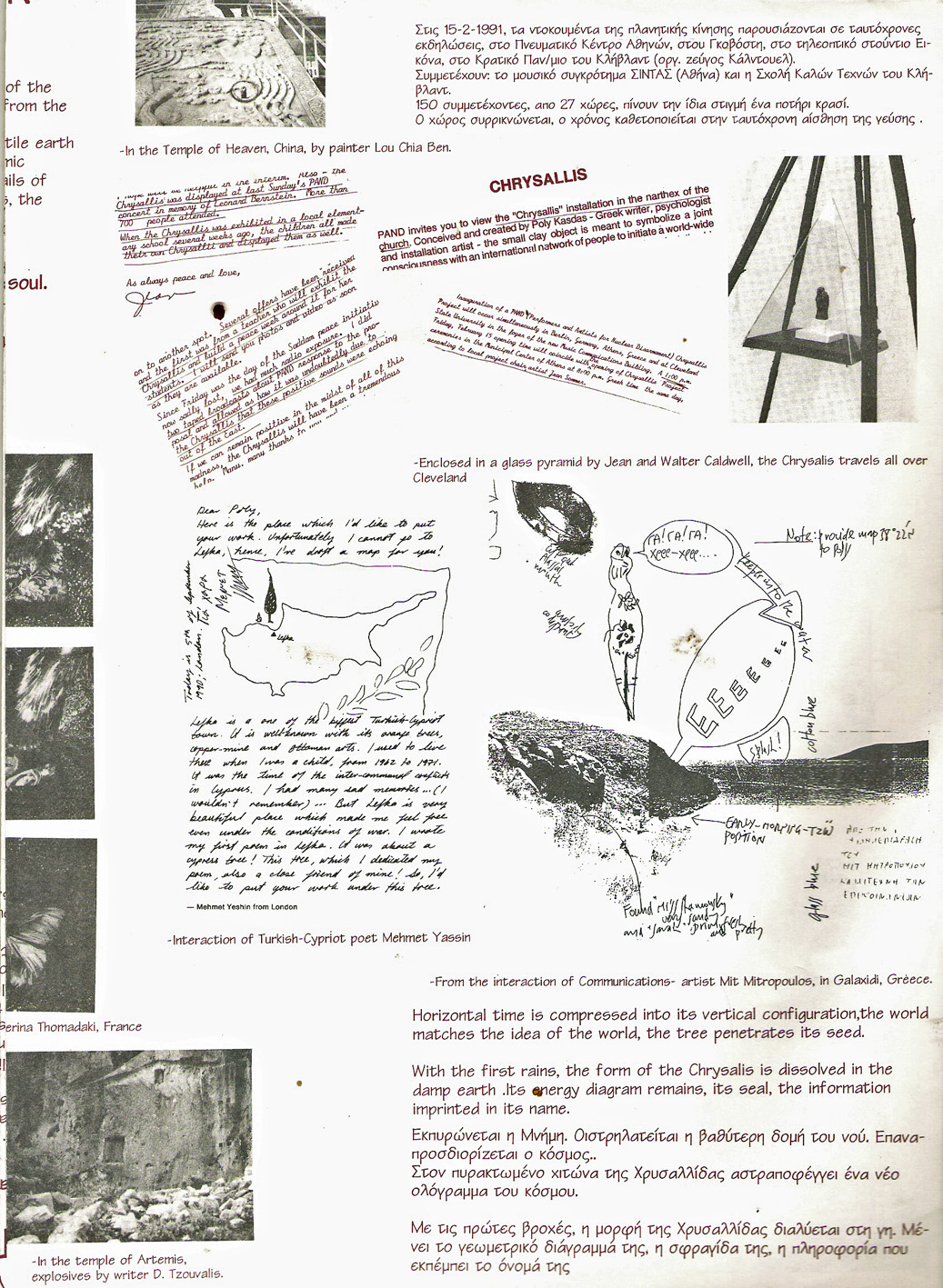
The polycentric interactors' documentation was augmented by a UCT world -on- the- make libation 15-2-1991, in the acoustic structure dictated by the algorithm of the word ΧΡΥΣΑΛΛΙΣ performed by SIDAS musical group dispersed in the crowd.
Narrative-articles springing from the above sub-project:
P. Kasda,The Silenziosi and Project Myth/Network 1990-2005 in Art-Act, Tyflomyga revue, December. 2005. (Greek)
P. Kasda, Project: Myth/Network 1990-1994: Revival of cosmological Memory in our spacetime redefinition, Tetarti Apostoliki, Pinacotheque of the Municipality of Athens catalog, T.E.E. 1994.
P. Kasda, “Logos”, ENOPE Center of Arts and Sciences, booklet 2/11/1992.(Greek)
P. Kasda, Sky inside, sky outside, Emvolimon magazine nb.8, Aspra Spitia Boetia, Greece 1990.
P. Kasda, Progetto Myth/Network 1-5, La Clessidra1, Joker, magazine, Italy 1995.
P. Kasda, The Network, Govostis ed. 1991.
Dedication to Polyxene Kasda, Project Myth/Network interview, Tyflomyga, September, Athens 2003.(Greek)
P. Kasda, Project Myth/Network 1990-1995, TV documentary by Makis Faros, production Icona,
P. Kasda, Chrysalii, a mythological experience, Politistiki ekfrassi/ Cultural Expression journal, interview, Athens 1991.(Greek)
http://uraniasgardens.blogspot.gr/2009/01/chrysalis-chronicle.html,
Threshold performance /Global installation by Polyxene Kasda in 1990 (Ibid).
the above sub-projects are all facets of hyper-project Myth/Network -1990-2015- : a 4D scattering matrix of inter-weaved sub-projects set at the interface of ritual/actual time, emerging from depth psychology and multi-plexing in overview dispersive structures; time shift traces of my threshold instant performance in the bottom of the Lake of Mornos, Greece 1990.


Project Myth/Network was launched in the Museum of Modern Art of Joensuu Finland, PAND Meeting of the Worlds conference 1990.
Archives: Project Myth/Network: emst.gr/gr/collections National Museum of Modern Art archives code 1595. Donation: Xagoraris 1991.
They wrote:
"Under-determination is transcribed in the work of Poly Kasda as scattered traces of language, objects, performances...which may reveal or conceal the true meaning, the core of her objectives. A core attracting into its orbit scientific theories of computational and cognitive science along with the philosophical and applied concepts of experience".
 Mariana Ziku, art historian, Under-determination in poly Kasda's work, Stoa tou Vivliou, 2/6/2016 Athens
"She manages with a pre-scientific way’ Paracelsus, Leonardo’s , the witch-doctor’s and Huomo Universalis’ to connect the tangible with the intangible and to manifest in front of our eyes invisible dynamic lines that lend to our world a little more meaning"
Dr. Yannis Almyrandis, Democritus institute of bioscience research and applications, Over-determination in poly kasda’s work, 2/6 Stoa tou Vivliou Athens
"At each and every point of her art, Kasda re-casts and re-interprets mythological and philosophical concepts bringing them back to life transfigured in aesthetic form of the highest quality".
Dr. Yael Navaro-Yashin 2010, anthropologist, essayist, senior university Lecturer, recommendation for EN, Cambridge 2010.
“In Kasda's projects original and unpredictable social “language games” are set up and left to evolve creating a multitude of narratives”.
Dr. John Kontos, Artificial Intelligence Professor John Kontos needles Poly Kasda's Conscious Eye”, NotiosAnemos/South Wind/Amazon 2015.
Through collective synergy sustained by pure subjectivity, her itineraries- maps enriched with graphisms- are transformed into an embodiment experience for the participants, tending to be reduced into abstraction, through logical elaboration and writing. To seek to enter in this dimension seems at first sight difficult, but, once you accept to make the effort, doors will open to unsuspected dimensions”.
Donatella Bisutti, poet, writer, editor, “Polyxene Kasda Myth/Network”, La Clessidra 1/1995, Joker, Italy
"Project Myth/Network is a state which is configured as much by the artist as by the participants in her growing interactive web. It is an open system that evolves on many ontological levels”.
Elzbieta Koscielak, ΑICA art critic, “Myth/Network: The vision of an open system in Art”, The Network,, Govostis, Athens 3/2/1991.
“She belongs to an ancient and ever actual existential forefront, as, by analogy, the Pythagorean and Orphic mysteries would seem advanced today. The ancient mystery with its three folds- τα δεικνύμενα (the things shown), τα λεγόμενα (the things said) και τα δρώμενα (the things done) – is the type and form of creation that inspires and expresses Polyxene Kasda”.
By revisiting myth, Polyxene, crucial-timer artist, reconstructs history itself. Through the study of the landscape magnified by observation, scientific research, linguistic analogies and the involvement of residents in her work, her project is a precious “doc” important for future generations".
Dores Sacquegna, art-curator, gallery director, Celestial Fragments, Primopianogallery, Lecce, Italy.
Victor Ivanovici, writer, essayist, literary critic, Athens 2005.
Polyxene Kasda is IAA UNESCO artist, studied Chemistry-Physics in A.U.C Cairo, graduated in Psychology-Sociology in A.C.G. Athens.


